

A Winter Storm, Cajun Engineering, and the AI Skill we Should be Teaching

A Winter Storm, Cajun Engineering, and the AI Skill we Should be Teaching
It started with graupel — those strange little pellets of soft hail that most people in North Louisiana have never seen, let alone planned for. Within hours, the graupel gave way to freezing rain, and then the power went out. It would stay out for eight days, eight very cold days.
My wife Tracy and I live on a small ranch outside Monroe, Louisiana. We have a home standby generator and a 500-gallon propane tank that was full when the storm hit. We also had access to a huge supply of firewood. The pantry was stocked, bathtub full and plenty of drinking water was at hand. In theory, we were prepared. In practice, eight days of running a generator around the clock while also heating the house will test anyone’s confidence in the word “full.”
What I want to tell you about isn’t the storm itself, though. It’s about what happened between me and a generative AI over those eight days , and what it reveals about a quality of these tools that I think is vastly underappreciated in higher education.
The generators fails
After losing power for almost a week after Hurricane Laura, we invested in a whole house standby generator. It’s been awesome. If we lose power, within seconds the generator kicks on and we’re back to normal. The generator is fueled by a massive 500-gallon propane tank. Since we don’t use much propane, the tank is almost always close to full. So, when we lost power early Saturday afternoon, I wasn’t overly concerned. I went to bed as normal, but around 9:30, Tracy woke me and told me the generator had died. I bundled up, grabbed a flashlight and went into the snow and freezing rain to check. Without going into detail, the problem was that a vent on the propane tank’s regulator had frozen over, triggering the regulator to shut off the flow of propane to the generator. My neighbor told me to pour water over it to thaw it, and I tried wrapping it in blankets and a tarp, but that just plugged up the vent. A few hours later, and I had the same problem. I went through the water routine again and got the generator fired back up, but I needed a longer-term solution.
That’s when I turned to AI, specifically Gemini in this case. I told Gemini what was going on, and we went back and forth and came up with a cobbled-together solution, one that looked crazy, but worked. The solution involved a plastic tub, straps and bungee cords, a couple of garden trellises and a shop light with an old school incandescent light bulb. At the time, I thought about the absurdity of it all. Here I was using one of the most advanced technological tools we’ve ever seen to come up with a cobbled together solution in the midst of a winter storm. You can see the result below.
Yeah, I know how it looks, but IT WORKED! The vent did not freeze again and the generator ran flawlessly (with one exception) for the duration of the outage. The only time it stopped is when I shut it down for the daily oil check.
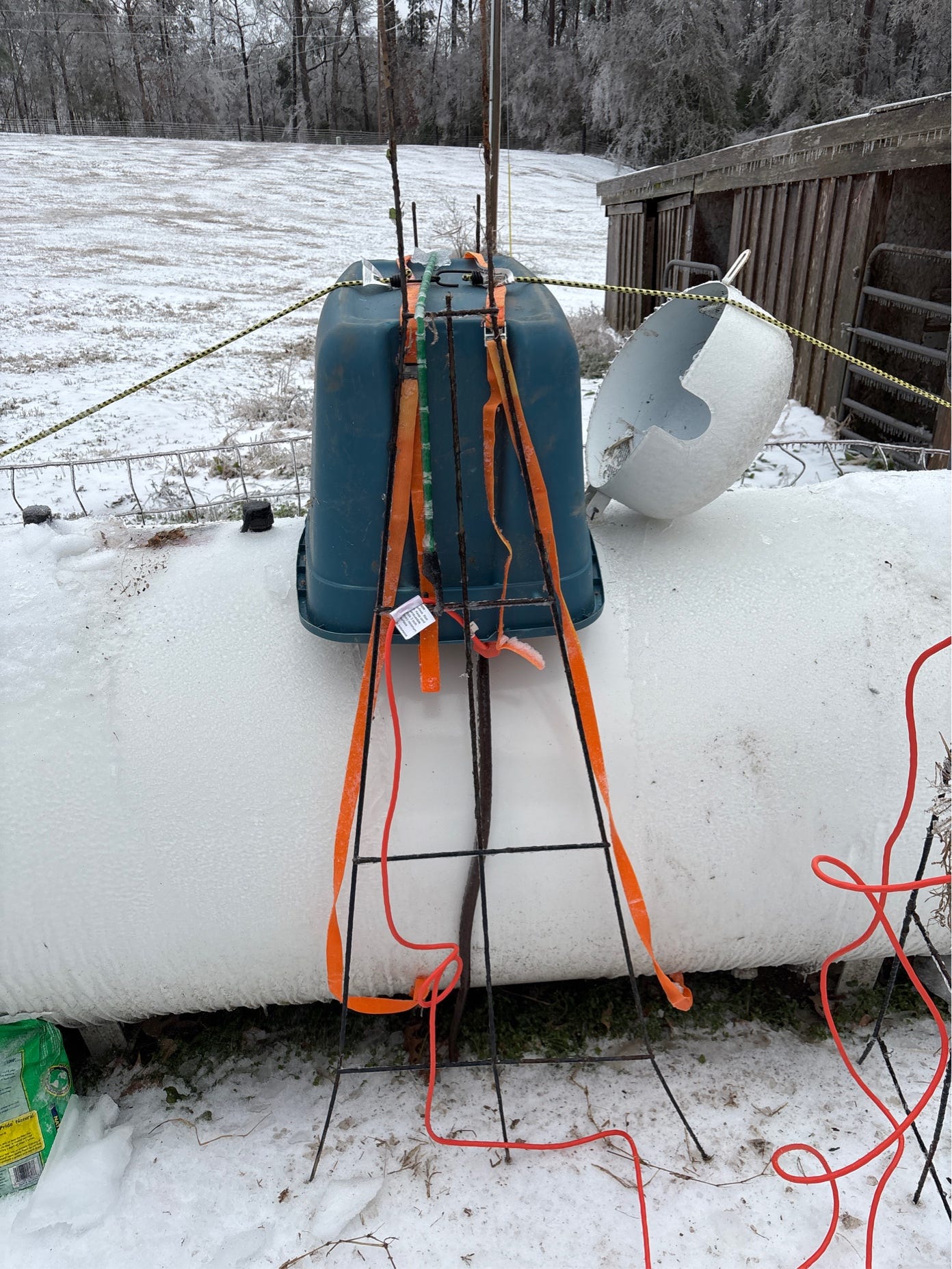
You’re seeing the final result in this picture, but it was a process of iteration. I would rig something up, take a picture, show it to Gemini. Gemini would say, change this, change that, and eventually this is what we landed on, although I did cover it with a tarp to keep the wind out. One of the really interesting aspects of this was that Gemini’s initial solution wouldn’t work in my particular circumstance. So we went back and forth discussing the possibilities and what I had on hand. The end result wasn’t pretty, but it was effective.
To me, this is a great example of collaborative use of AI. What I’ve been calling human-AI co-produced cognition. AI could not have come up with this solution on its own because it didn’t know what materials I had available, and I certainly never would have thought of anything like this on my own, but together we put together an effective solution in the midst of a winter storm. AI wasn’t just an answer machine, it was a thinking partner. Gemini knew the thermodynamics, I knew what I had available. Together we solved a huge problem.
The one exception in the generator’s performance wasn’t really a generator problem, it was a Craig problem. When I restarted the generator after thawing the regulator, the generator soon became overloaded and shut down. I turned to human help this time (my neighbor, who is an electrician) and we turned off breakers to reduce the load. That led to my next set of problems.
Can I make coffee?
Do you know how much power an old school Mr. Coffee drip coffee maker draws? Me neither, but Gemini did. The next morning, when I wanted my caffeine fix, I asked Gemini if it was safe to turn on my coffee maker. I soon had the answer I was looking for and got the green light to make the coffee. It turns out that when it’s heating, a drip coffee maker draws a fair amount of power, but once the coffee’s brewed, keeping it hot doesn’t take much at all. We were still well within the generator’s limits. Gemini was able to do some quick calculations based on my input about what systems we had running. What was even more important is my wife was able to take a shower because Gemini said it was okay to run her hair dryer. In this case, there was no co-produced cognition. AI was an answering machine, but that’s what I needed at the moment. There was no melding of brains here. It was more like looking something up and doing a little bit of math. Here’s the important point: it was the same tool, the same mode of interaction, but very different uses.
Here are just a few of the other ways Gemini helped during the storm:
Figuring out how to turn off auxiliary heat strips (which draw a huge amount of power).
Telling me the safest sequence for shutting down to check the generator’s oil, and the best way to restart our systems.
Calculating our propane burn rate and estimating how long we could go before the tank hit empty, which mattered more and more as the outage continued.
Helping me accurately read the generator’s oil level in bad light.
Developing an emergency plan for deploying and running our backup generator in case we ran out of propane. (Fortunately, we got a delivery before that happened.)
Overall, Gemini seamlessly moved between answer machine and thinking partner as the task required. That brings me to the point of this article. Many in higher ed have been thinking about AI and its impacts in the wrong way. In practice, AI is not a single “thing,” it’s an almost endless array of possibilities.
The Affordance Space No One Talks About
In higher education, we’ve spent the last few years debating generative AI through the lens of a single affordance: writing things for students. This framing has driven policy conversations, academic integrity concerns, and many (most?) of our pedagogical experiments. But this is like evaluating electricity entirely on its ability to power a light bulb.
An affordance is simply a possibility for action that a tool makes available. A hammer can pound nails, but it can also be a paperweight. A pen affords writing, but can also open a pesky bag of airline pretzels. Simple tools have simple affordance spaces. Generative AI, on the other hand, has an enormous affordance space, one that seems limitless. More importantly, generative AI is fluid; it reshapes itself around whatever cognitive task you bring to it.
During the storm, I didn’t switch tools when my needs changed. I didn’t consult a manual about which “mode” to use. The same AI that helped me reason through a novel thermodynamic problem seamlessly became a reference source for electrical load calculations, then an external memory tracking maintenance intervals, then a planning partner for contingency scenarios. One moment it was a co-thinking partner, the next a calculator, the next a librarian.
That fluidity is what we should be teaching and aren’t. We frame AI as a writing tool (or worse, as a cheating tool). We collapse AI’s vast affordance space into a single use.
We need to be teaching affordance recognition, the metacognitive ability to look at a situation and perceive the range of ways an AI partner might help you think, decide, calculate, remember or create within it. We can’t do that through AI policy (although policy is important), it’s a skill that can only be built through practice across varied, meaningful contexts.
Graduate students working on their dissertations face shifting affordance needs constantly. Sometimes they need a thinking partner to work through a theoretical tangle. Sometimes they need help formatting a table. Sometimes they need a sounding board for whether an argument holds together. The question is whether we’re preparing them to recognize and navigate that fluid space, or whether we’ve trained them to see only one thing when they look at the tool.
The propane held out, by the way. A delivery truck made it down our road on day seven. The power came back the next day. And every morning, I made my coffee.
Want to continue this conversation? I’d love to hear your thoughts on how you’re using AI. Drop me a line at Craig@AIGoesToCollege.com. Be sure to check out the AI Goes to College podcast, which I co-host with Dr. Robert E. Crossler. It’s available at https://www.aigoestocollege.com/follow.
Looking for practical guidance on AI in higher education? I offer engaging workshops and talks—both remotely and in person—on using AI to enhance learning while preserving academic integrity. Email me to discuss bringing these insights to your institution, or feel free to share my contact information with your professional development team.
What a fantastic example of human and AI inventiveness, versatility, and collaboration! And so well told! I take it as a profound story where time bends back on itself, from the tool of cutting-edge AI to tool use during the origins of humanity, when we had to learn how to stay warm, build things, solve problems, etc. I'm glad you got your heat back!
Wow, sounds like you had quite the adventure. Our power gets knocked out somewhat consistently here in Michigan at certain points in the winter and in the summer months, but I've never lost it for days at a time, thank God.
I use AI very much the way that you do. And you would not have been able to as easily or effortlessly figure this out without having it. That's what makes this so amazing to be able to use. I used it to fix my refrigerator, which I would have never been able to do. It just gives you the ability to do things that you've never been able to before. And that is the beauty of this technology, but there is definitely a dark side to it.
But it's really hard to argue it has no utility. I'm just perplexed by people that are completely against using it for anything.